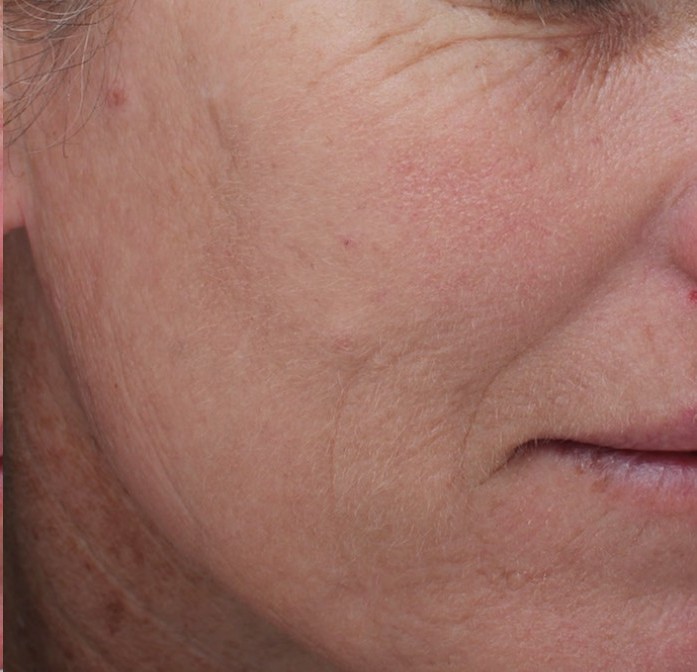
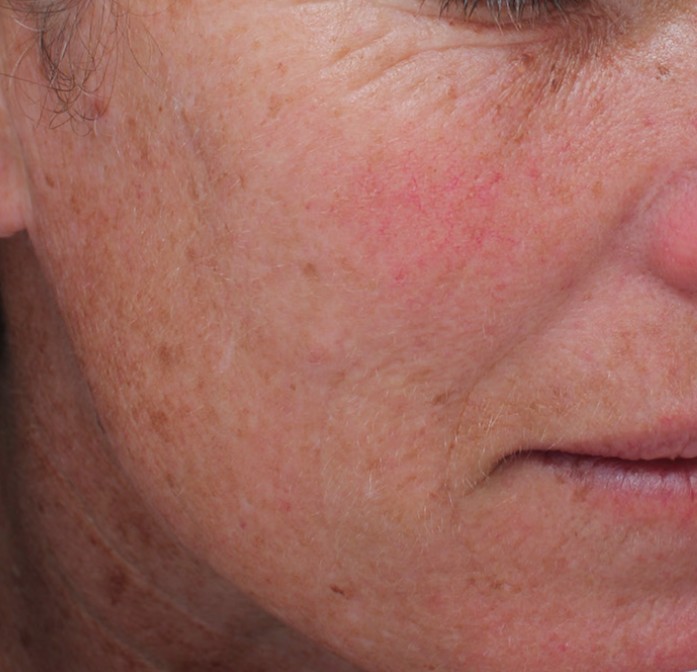
How does MOXI Laser work?
MOXI uses a 1927nm thulium fiber laser delivered in a fractional pattern, creating thousands of microscopic columns of sub-surface thermal damage (MENDS, microscopic epidermal necrotic debris) while leaving the surrounding tissue intact to enable rapid healing. Unlike ablative lasers that vaporize tissue, MOXI's non-ablative delivery means the outer layer of skin (epidermis) remains physically intact during treatment.
The 1927nm wavelength is particularly suited to targeting superficial pigmentation and promoting epidermal renewal[1]. Water in the skin preferentially absorbs this wavelength, creating controlled thermal coagulation columns that extend from the epidermis into the upper dermis. As the surrounding intact tissue drives rapid repair of these columns, the damaged pigmented cells and aged keratinocytes are replaced with fresh, more evenly pigmented skin.
▸
The 1927nm wavelength has approximately 3–5x higher water absorption than the 1550nm wavelength used in Fraxel Restore, giving MOXI preferential superficial activity for pigmentation and epidermal renewal with less penetration depth than deeper non-ablative fractional devices.[2]
Because MOXI's fractional treatment zones are less densely packed and shallower than Halo's, each individual session delivers gentler results, but a series of 3–4 treatments accumulates significant improvement in skin tone, texture, and overall quality with minimal recovery per session. This makes MOXI the preferred choice for people who prioritize convenience and gradual, maintenance-style rejuvenation over single-session dramatic change.
What skin concerns does MOXI treat best?
MOXI is specifically optimized for superficial pigmentation correction and early photoaging prevention. Solar lentigines (age spots), diffuse sun damage, melasma maintenance, and general uneven skin tone are MOXI's primary clinical targets. The 1927nm wavelength's preferential absorption by melanin-containing epidermal cells drives their selective destruction and replacement with fresh, more evenly pigmented cells.
Skin texture refinement and general quality improvement are secondary benefits. The collagen stimulation from the fractional thermal injury is less aggressive than with Halo or Fraxel, but over a series of treatments produces meaningful improvement in fine line appearance, skin smoothness, and pore visibility. MOXI is often described as producing a "glass skin" effect, clear, smooth, and radiant, after a series.
▸
MOXI is one of very few fractional lasers regularly used in Fitzpatrick skin types IV–VI without significant pigmentation safety concerns, making it a primary choice for people with darker skin who want laser-based sun damage correction[3] and rejuvenation without ablative risk.
MOXI is also used in combination with BBL (BroadBand Light) as part of the "BBL + MOXI" protocol, BBL addresses vascular lesions, redness, and deeper pigmentation while MOXI refines the surface. This combination is offered as a highly popular "lunchtime" rejuvenation protocol that addresses multiple concerns with minimal combined downtime.
What happens during a MOXI Laser procedure?
A MOXI session is straightforward and typically takes 30–45 minutes including numbing time. Topical anesthetic cream is applied for 20–30 minutes. During treatment, a cooling handpiece is used to minimize discomfort. Most people describe the sensation as a warm, prickling feeling across the treatment area, noticeably milder than Halo or Fraxel.
The provider passes the MOXI handpiece over the treatment area in overlapping rows, covering the full face in a single pass. Treatment settings, energy level and coverage density, are adjusted based on skin type and concern. Darker skin types receive more conservative settings with lower energy and density; lighter skin types can be treated more aggressively.
Post-treatment, a cooling serum and gentle moisturizer are applied. Skin appears red and feels warm, similar to a mild sunburn. The provider applies SPF before the patient leaves. Fine MENDS dots appear over days 2–3 and shed naturally by day 3–5 with gentle cleansing.
What results can I expect from MOXI Laser?
A single MOXI session produces noticeable improvements in skin brightness and texture after the MENDS shed, typically visible from day 5 onward. People describe skin appearing cleaner, more even, and more luminous. Age spots and areas of diffuse pigmentation appear lighter and more uniform.
Over a series of 3–4 sessions, the cumulative effect produces significant improvement in overall skin quality, progressive pigmentation correction, finer pore appearance, smoother texture, and an evenness that people frequently describe as "glassy." Full results from the series are typically visible at 3 months as collagen maturation completes.
Because MOXI is designed as a maintenance-oriented device, many people continue with annual or biannual sessions as part of a long-term skin health protocol. This ongoing approach effectively prevents new photodamage from accumulating, maintaining a consistently high skin quality baseline.
Not sure if MOXI Laser is right for you?
Download Vera to understand where MOXI fits in your skin plan, what to compare it with, and which Vera Verified providers you can book for a consult.
Download Vera
What is the downtime after MOXI Laser?
MOXI's downtime is one of its defining advantages. Immediately after treatment, skin is red and slightly warm, comparable to a mild sunburn. Swelling is minimal. Most people are comfortable returning to non-strenuous work or social activities the same day or the following morning, with SPF and a gentle moisturizer.
Days 2–3: fine MENDS appear as a sandy or grainy texture on the skin surface, tiny dark dots that give the skin a stippled appearance under magnification. These are significantly less visible and dramatic than Halo's MENDS. People can wear makeup lightly from day 2 to cover residual redness.
Days 3–5: MENDS shed naturally with regular cleansing, revealing smoother, brighter skin underneath. By day 5 most people have no visible signs of treatment and have returned to full skincare routine. Compared to Halo's 5–7 day visible recovery or Fraxel's 3–5 days, MOXI's 2–4 day recovery makes it highly practical for people with busy schedules.
Who is a good candidate for MOXI Laser?
MOXI is one of the most broadly applicable laser treatments available. Its low-intensity, non-ablative delivery makes it suitable for a wide range of people, from younger adults (mid-20s onward) seeking preventive maintenance to older people accumulating sun damage. It is particularly well-suited for people with darker skin tones (Fitzpatrick types IV–VI) who want laser-based improvements with minimal pigmentation risk.
MOXI is frequently chosen by people who want consistent, ongoing skin quality maintenance rather than a single dramatic intervention. It fits naturally into a regular skincare protocol, similar to how some people approach regular facials or peels, but with more durable biological results at the cellular level.
People with more significant photoaging, deeper acne scars, or pronounced skin laxity may find MOXI insufficient as a standalone treatment and may be better served by Halo, Fraxel, or RF microneedling for those specific concerns. MOXI excels as part of a combination protocol, for example, BBL + MOXI for vascular and pigment correction, or Halo + MOXI maintenance annually after an initial Halo session.
How much does MOXI Laser cost?
MOXI is generally the most accessibly priced Sciton fractional device.
- United States, full face, per session: $400–$800
- United States, major urban markets (NY, LA): $600–$1,000
- United States, typical course (3–4 sessions): $1,200–$2,500
- BBL + MOXI combination, per combined session: $800–$1,500
MOXI is often offered as a "refresher" treatment at reduced pricing for existing people who have previously undergone Halo and want maintenance. The combination of lower per-session pricing, limited downtime, and broad safety profile across skin types can make it a practical fractional laser option for long-term maintenance. Compare the total course cost, expected recovery, and pigment-safety considerations before choosing it over stronger resurfacing lasers.