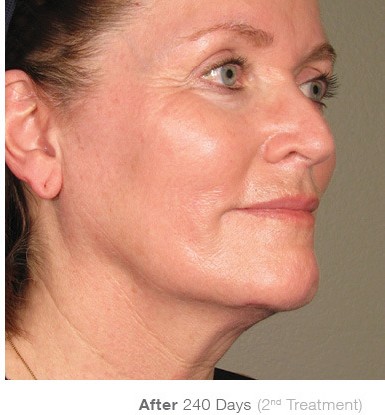
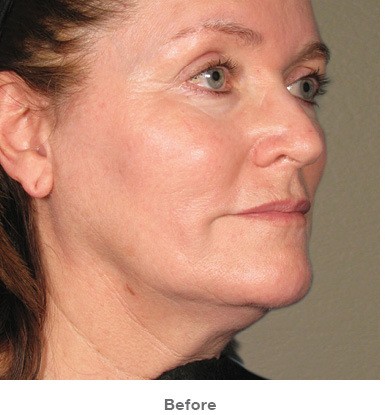
How does Ultherapy work?
Ultherapy delivers precise, focused ultrasound energy to specific tissue depths, 1.5mm, 3mm, and 4.5mm[3], corresponding to the dermis, superficial subcutaneous tissue, and SMAS (superficial musculoaponeurotic system) layer respectively. At each focal point, the energy creates a micro-coagulation zone: a tiny, controlled thermal injury that triggers the body's wound-healing response.
The healing response stimulates fibroblasts to produce new collagen and elastin, gradually tightening and lifting the treated tissue[2]. Because the energy bypasses the skin surface entirely (similar to how focused ultrasound can heat deep tissue without burning the overlying skin), there is no surface injury and minimal downtime.
▸
Ultherapy is the only non-invasive treatment FDA-cleared for lifting the brow, submental chin, and neck: based on the ability to target the SMAS layer at 4.5mm depth, which is not achievable by radiofrequency or laser devices[4].
The Ultherapy system includes a real-time imaging component that allows practitioners to visualize the tissue layers being treated, enabling precise placement of energy at the correct depth for each patient's anatomy.
What can Ultherapy treat?
Ultherapy holds FDA clearance for three specific indications: (1) non-invasive lifting of the brow, (2) non-invasive lifting of lax submental (under-chin) and neck tissue, and (3) improvement of lines and wrinkles on the chest (décolleté). In practice, it is used broadly for:
- Facial laxity: Jowling, loss of jawline definition, midface descent
- Brow ptosis: Lifting the lateral brow position non-surgically
- Neck and submental laxity: "Turkey neck," platysmal banding, chin-neck junction improvement
- Décolleté rejuvenation: Chest lines and skin laxity
- Off-label body areas: Upper arms, inner thighs, abdomen (skin laxity)
Ultherapy is most effective for people with mild to moderate laxity. People with severe sagging are typically better served by surgical options such as a facelift.
How is Ultherapy different from Morpheus8?
Both Ultherapy and Morpheus8 address skin laxity and stimulate collagen, but through distinct mechanisms and at different tissue depths. Ultherapy uses ultrasound energy to target the SMAS layer (up to 4.5mm), stimulating collagen without touching the skin surface, making it a purely non-invasive lifting treatment with no downtime. Morpheus8 uses microneedles to physically penetrate the skin and deliver RF energy into the dermis and subcutaneous fat, which makes it more effective for skin texture, enlarged pores, fine lines, and superficial fat remodeling.
A key clinical distinction: Ultherapy reaches the SMAS layer, the same tissue plane addressed by a surgical facelift, while Morpheus8 delivers RF energy through microneedle channels into the dermis and subcutaneous fat, with a different mechanism of action.
Many providers use Ultherapy and Morpheus8 as complementary treatments: Ultherapy for structural lifting of the SMAS layer and Morpheus8 for skin quality improvement and superficial fat sculpting. The right choice depends on which concern is primary, structural laxity versus skin texture and fat.
What does the Ultherapy treatment process look like?
Ultherapy is performed in a single session, typically lasting 60–90 minutes depending on the areas treated. Here's what to expect:
Consultation: Your provider assesses facial anatomy, tissue depth, and laxity severity to determine which transducer depths and lines (passes) are appropriate. They'll discuss pain management options.
Preparation: A coupling gel is applied to the treatment area. Oral pain management, commonly ibuprofen, acetaminophen, or a prescribed anxiolytic, is taken 30–45 minutes before the session.
Imaging: The Ultherapy handpiece includes an ultrasound imaging component. Your provider views the tissue layers in real time to confirm correct depth placement before delivering treatment energy.
Energy delivery: Short pulses of focused ultrasound create micro-coagulation zones at the targeted depths. You'll feel a heating or "zapping" sensation, described by many people as brief but intense, at each energy point.
Post-treatment: Mild redness, swelling, and tingling are common and resolve within a few hours. Most people return to normal activities the same day.
Results timeline: Initial collagen contraction may create subtle tightening within weeks. The full collagen remodeling effect develops over 2–3 months.
Who is a good candidate for Ultherapy?
Ultherapy delivers best results for people who:
- Have mild to moderate facial, neck, or brow laxity
- Are not ready or not interested in surgical lifting procedures
- Have good skin quality, Ultherapy tightens existing tissue but does not improve skin texture or tone
- Are willing to tolerate some procedure discomfort in exchange for no downtime
- Can wait 2–3 months for results to fully develop
Ultherapy is not appropriate for people with severe laxity (surgical results will be significantly superior), active skin infections in the treatment area, implanted devices or metal in the treatment zone, or very thin skin with significant fat loss.
▸
In published clinical studies, 64–93% of people showed measurable brow elevation on standardized photographic assessment at 90 days post-treatment, with mean brow lift of approximately 1.7mm[1].
Not sure if Ultherapy is right for you?
Download Vera to see what to consider first, what can wait, what it may cost, and which Vera Verified providers you can book for a consult.
Download Vera
What are the risks and side effects of Ultherapy?
Ultherapy has a well-established safety record, but the following side effects and risks are documented:
- Procedural discomfort: The most commonly cited concern, most people find it uncomfortable; oral pain management significantly improves tolerability
- Transient redness, swelling, and tingling: Common immediately after treatment; typically resolves within hours to 1–2 days
- Bruising: Uncommon but possible at higher energy settings or over bony prominences
- Temporary nerve symptoms: Rare reports of temporary numbness or tingling in the treatment area, resolving within weeks
- Fat atrophy: A risk at incorrect treatment depth, if energy is delivered into the wrong tissue plane, localized fat reduction can occur. Real-time imaging guidance significantly reduces this risk.
- Marginal mandibular nerve injury: Rare; can cause temporary asymmetry of lip movement; resolves spontaneously
Choosing an experienced provider who uses the real-time imaging feature consistently and properly calibrates energy levels for each patient's anatomy significantly reduces complication risk.
How much does Ultherapy cost?
Ultherapy is among the higher-cost non-surgical aesthetic treatments, reflecting its single-session protocol and device investment. Pricing in the US:
- Full face + neck: $3,000–$5,000
- Face only: $2,000–$3,500
- Neck only: $1,500–$2,500
- Brow lift or décolleté: $1,000–$1,800
Pricing is often by the number of "lines" (passes) delivered, with more lines providing broader and deeper coverage. Be wary of significantly discounted Ultherapy, reducing the number of treatment lines is a common way providers cut cost, but this typically reduces efficacy significantly.
Standard full-face Ultherapy is delivered across multiple transducer depths with a clinically meaningful number of lines per zone. Deeply discounted packages often achieve their price by reducing the number of treatment lines, which can produce noticeably less lifting, so always ask how many lines are included.